
Alstonia scholaris (Devil’s Tree) 20 Seeds
$ 3.09
Alstonia scholaris (Devil’s Tree) 20 Seeds
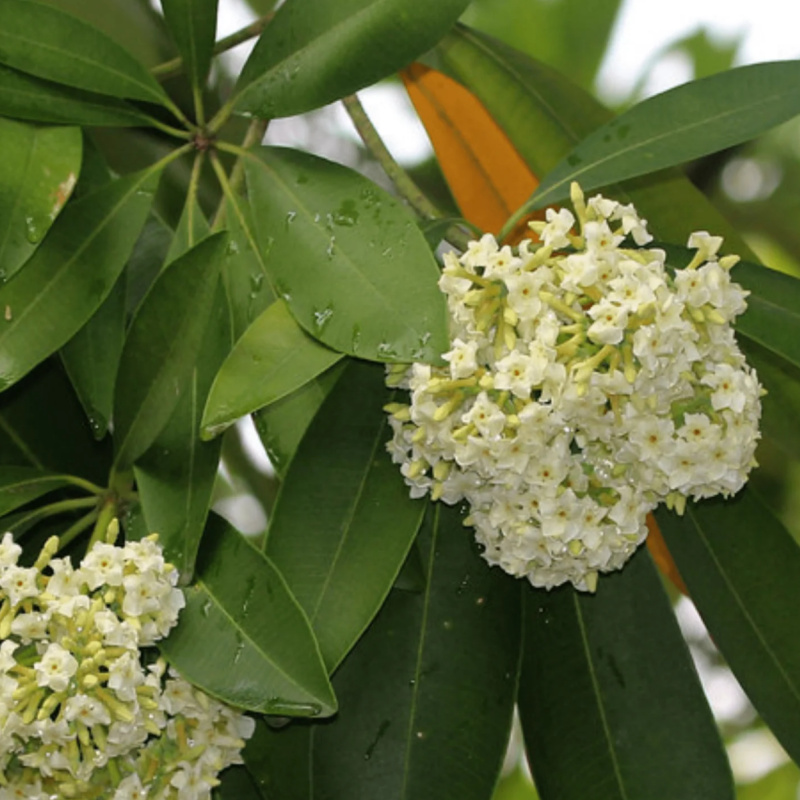
Description Alstonia scholaris, commonly known as Devil’s Tree, is a tall, elegant evergreen tree in the Apocynaceae family, native to southern China, the Indian subcontinent, Southeast Asia, Indonesia, the Philippines, Australia, and the Solomon Islands. Rarely found outside its natural range, it is valued both for its striking ornamental presence and its long history of traditional use. The tree features a beautifully regular branching habit, whorled, leathery dark green leaves, and large clusters of small, intensely fragrant green-white flowers that typically appear in spring. Mature bark is greyish, while younger branches are marked with prominent lenticels and exude a bitter, milky sap. Known in traditional medicine as Dita Bark, the bark and roots are rich in bitter alkaloids and have historically been used as a substitute for quinine, particularly in the treatment of malaria. Across Asia, Australia, and parts of Africa, Alstonia scholaris has been an important ethnobotanical species, traditionally employed as an astringent for digestive complaints such as abdominal pain, chronic diarrhoea, and dysentery, as well as for toothaches and snakebites. Leaves have been used in remedies associated with beriberi, while the latex has been applied to clean wounds and even used as a base for chewing gum. The fragrant flowers yield an essential oil, and the seeds are noted in some Indigenous Indian traditions for their use in ritual contexts. Common Name. Blackboard Tree; Scholar Tree; Milkwood; Dita Tree Germination. To germinate Alstonia scholaris seed, sow at anytime of year in well-draining, sandy soil, covering only lightly. Keep moist at between 20-25 degrees Celsius for best results. Seeds sometimes germinate within 4 to 6 weeks, although some may take very much longer so remain patient. Disclaimer: We personally count every seed packet to ensure it contains at least the specified number of seeds. However, mistakes can happen, so please reach out if you notice any inconsistencies. These seeds are believed to meet the standard viability percentage for their species, sourced either from our own SAB nursery or from reputable, trusted breeders. Do not hesitate to contact us for up-to-date germination rates or for a germination test to be conducted. Interested in the Alstonia species? Check these products out Rubus rosifolius (Roseleaf Bramble) 30 Seeds Adansonia digitata (African Baobab) 5 Seeds The Weed Forager’s Handbook. A Guide to Edible and Medicinal Weeds in Australia (2nd Ed.) by Adam Grubb & Annie Raser-Rowland
Related products
-
Sale!Select options
This product has multiple variants. The options may be chosen on the product page
-
Sale!Select options
This product has multiple variants. The options may be chosen on the product page
-
Sale!Select options
This product has multiple variants. The options may be chosen on the product page